
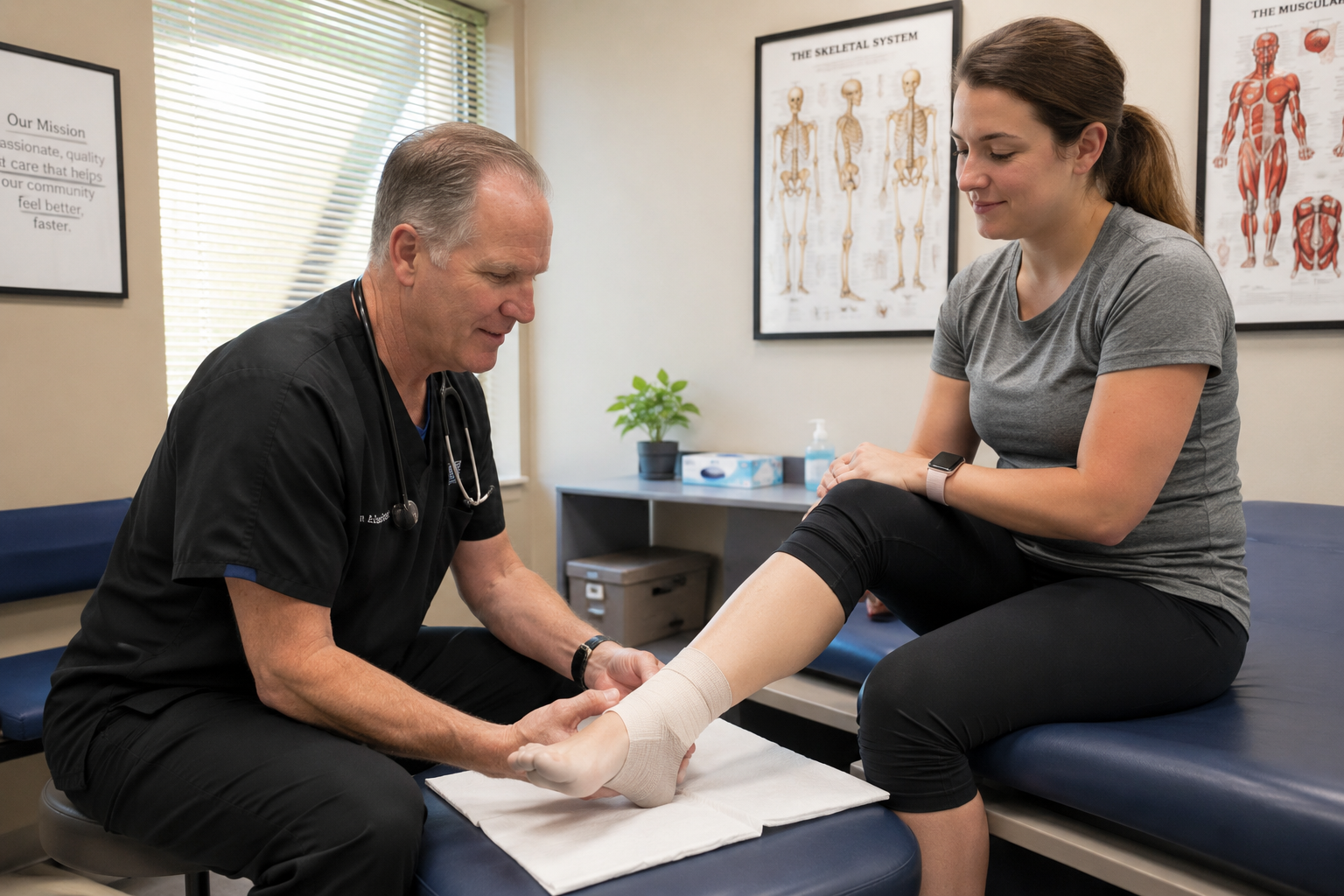
Can Urgent Care Treat Minor Sprains and Strains?
Yes, urgent care can often treat minor sprains and strains, especially when the injury is painful but not life-threatening. These injuries are common after falls, sports, exercise, lifting, twisting, or everyday accidents.
A sprain happens when a ligament is stretched or torn. Ligaments connect bones at a joint. A strain involves a muscle or tendon. Both can cause pain, swelling, bruising, stiffness, and difficulty using the injured area. MedlinePlus describes sprains and strains as common injuries that may cause pain, swelling, bruising, and trouble moving the affected joint or muscle.
At Sherman Medical, patients can visit for evaluation of many non-life-threatening injuries, including sprains, strains, sports injuries, and other everyday urgent care concerns.
What Is the Difference Between a Sprain and a Strain?
Sprains and strains can feel similar, but they affect different parts of the body.
A sprain usually involves a joint. It happens when a ligament is stretched or torn. Common sprain locations include:
- ankle
- wrist
- knee
- thumb
- elbow
A strain usually involves a muscle or tendon. It happens when the tissue is overstretched, pulled, or injured. Common strain locations include:
- back
- neck
- shoulder
- hamstring
- calf
- groin
Both injuries can range from mild to more serious. Some improve with rest and supportive care, while others may need medical evaluation, imaging, bracing, or referral.
When Urgent Care May Be a Good Option
Urgent care may be appropriate when the injury is not life-threatening but still needs medical attention. This is especially true if you are unsure whether the injury is a simple sprain, a muscle strain, or something more serious.
You may want to visit urgent care for a sprain or strain if you have:
- pain after a fall, twist, or sports injury
- swelling around a joint
- bruising
- difficulty moving the injured area
- pain when walking or using the joint
- tenderness that is not improving
- a popping or tearing feeling at the time of injury
- concern that the injury may need an x-ray
- symptoms that do not improve after home care
Mayo Clinic notes that mild sprains may be treated at home, but injuries that cause sprains can also cause more serious problems such as fractures. Medical evaluation is recommended if you cannot move or bear weight on the joint, have pain directly over bone, or have numbness in the injured area.
When You Should Go to the Emergency Room Instead
Urgent care is not the right place for every injury. Some injuries need emergency care right away.
Go to the emergency room or call 911 if you have:
- bone visible through the skin
- severe deformity of the limb or joint
- heavy bleeding
- severe pain after a major injury
- numbness, weakness, or loss of feeling
- blue, pale, or cold fingers or toes
- inability to move the injured area after a serious accident
- head, neck, spine, or chest injury
- symptoms after a major fall, car accident, or high-impact trauma
If you are not sure whether your injury is minor or serious, it is safer to seek medical care.
What Happens During an Urgent Care Visit for a Sprain or Strain?
During a visit for a sprain or strain, a medical provider may ask how the injury happened, where the pain is located, and what symptoms started afterward.
The visit may include:
- physical exam
- checking swelling and bruising
- checking range of motion
- evaluating tenderness and pain location
- checking whether you can bear weight
- deciding whether imaging may be needed
- guidance on rest, support, and follow-up care
For muscle strains, Mayo Clinic notes that a provider may check swelling and points of tenderness, and the location and intensity of pain can help determine the extent of the injury. (Mayo Clinic)
If there is concern for a fracture or more serious injury, imaging or additional evaluation may be recommended.
Can Urgent Care Provide X-Rays for Sprains and Strains?
Sometimes an x-ray is needed to help determine whether there may be a fracture or another injury. Not every sprain or strain needs an x-ray, but it may be considered when pain, swelling, bruising, tenderness, or difficulty bearing weight raises concern.
Sherman Medical offers on-site x-ray support, which can help with evaluation of many urgent care injuries in one convenient location.
What Can You Do at Home Before Being Seen?
For a mild sprain or strain, basic supportive care may help reduce pain and swelling while you decide whether medical evaluation is needed.
Common early care steps include:
- rest the injured area
- apply ice wrapped in cloth
- use light compression if appropriate
- elevate the injured area
- avoid activities that make pain worse
- consider over-the-counter pain relief if safe for you
Cleveland Clinic explains that the RICE method stands for rest, ice, compression, and elevation, and these steps can help reduce pain, swelling, inflammation, and bleeding in soft tissues soon after an injury.
MedlinePlus also recommends applying ice right away, wrapping the injured area to limit movement, keeping the area elevated, and resting the affected joint for several days.
However, home care is not a substitute for medical evaluation if symptoms are severe, worsening, or not improving.
Signs a Sprain or Strain May Need Medical Evaluation
You should consider being evaluated if you have:
- worsening pain
- significant swelling
- bruising that spreads
- trouble bearing weight
- joint instability
- pain directly over bone
- numbness or tingling
- limited movement
- symptoms that do not improve after a few days
- repeated injuries in the same area
Mayo Clinic notes that after the first couple of days, patients should see gradual improvement in movement or weight-bearing ability. Recovery time can vary, and sprains may take days to months depending on severity.
Common Sprains and Strains Seen in Urgent Care
Urgent care may evaluate many everyday injuries, including:
- ankle sprains
- wrist sprains
- knee sprains
- shoulder strains
- back strains
- neck strains
- sports-related strains
- work-related strains
- minor falls
- twisting injuries
- overuse injuries
For athletes, workers, parents, and active adults, getting an injury checked can help prevent worsening pain or returning to activity too soon.
Why It Is Important Not to Ignore Pain
Some patients try to “walk it off” after an injury. That may be okay for very mild soreness, but persistent pain, swelling, or limited movement should not be ignored.
Untreated sprains or strains can sometimes lead to:
- longer recovery
- repeated injury
- joint instability
- ongoing pain
- reduced mobility
- missed fracture or tendon injury
The goal of medical evaluation is to help determine what type of injury you have and what level of care is appropriate.